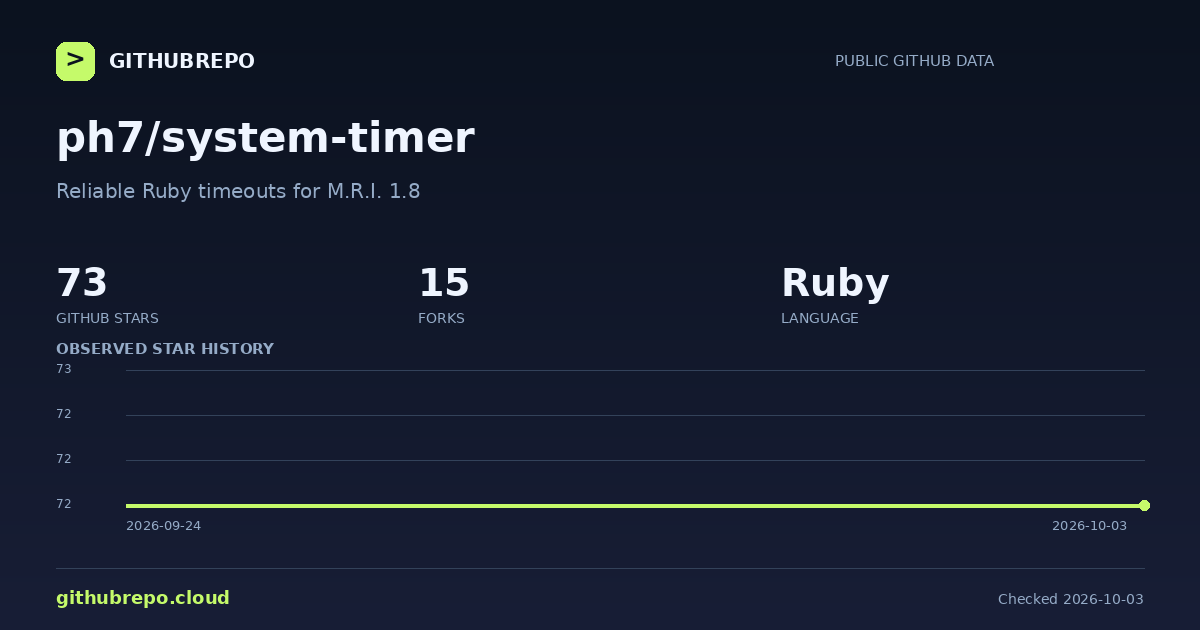
Reliable Ruby timeouts for M.R.I. 1.8
Star History

Momentum
+10
STARS · LAST 30 DAYS
1
PER DAY
#722
MOST-STARRED Ruby
| Window | 7 days | 30 days | 90 days |
|---|---|---|---|
| Stars gained | +7 | +10 | +90 |
| Per day | 1 | 1 | 1 |
| Forks gained | +1 | +3 | +10 |
system-timer gained 10 stars in the last 30 days, about 1 a day, and now has 73. It is about 18 years old and has averaged roughly 4 stars a year. It ranks #722 among Ruby repositories and #8,549 across all languages on GitHubRepo.
Trending Record
35
DAYS ON TRENDING
#100
BEST RANK
Jul 23, 2008
FIRST APPEARANCE
Active
STATUS TODAY
system-timer has maintained a continuous presence across global trending indexes, peaking at #100. Below is the 30-day activity profile:
💡 Overview
system-timer is an open-source project written in Ruby: Reliable Ruby timeouts for M.R.I. 1.8.
Engineered for speed, consistency, and developer ease, it solves common hurdles in Ruby. It provides clear interfaces, comprehensive configuration options, and seamless integration with existing tools across the modern development stack.
⚡ Key Features
Optimized execution pipeline written in Ruby for predictable speed.
Zero-friction configuration with comprehensive sensible defaults out of the box.
Cross-platform runtime support across Linux, macOS, and Windows environments.
Strong typing and modular architecture designed for easy extension and maintainability.
Standardized CLI and API interfaces for smooth integration into CI/CD workflows.
Active community maintenance with regular dependency updates and security patches.
📥 Installation
$ git clone https://github.com/ph7/system-timer.git
cd system-timer⚙ System Requirements
Platforms
- • macOS
- • Linux
- • Windows
Runtime & Dependencies
Ruby >= 3.1 with Bundler
Architecture
x86_64, ARM64 (Apple Silicon & Graviton)
🧠 How It Works
system-timer coordinates its core functionality through a modular Ruby pipeline. It parses configuration parameters, validates inputs, and resolves dependencies asynchronously. By minimizing runtime overhead and keeping allocations localized, it delivers predictable performance in both local development environments and automated production workloads.
🎯 Production Use Cases
Production System Integration
Embed system-timer into Ruby backend services to handle core application logic.
CI/CD Automated Pipelines
Run automated validation, builds, and integration suites during deployments.
Developer Tooling & Workflows
Accelerate developer onboarding with pre-configured project utilities.
Open Source Extension
Fork and customize internal modules under the repository's open NOASSERTION license.
🚀 Getting Started
Install system-timer using your package manager: `git clone https://github.com/ph7/system-timer.git`
Initialize your project workspace or configuration file for system-timer.
Import system-timer into your codebase or invoke it directly from your terminal.
Execute your test suite or run `system-timer --help` to verify successful setup.
👍 Strengths
⚠️ Considerations
⇄ Alternatives & Direct Competitors
👥 Who Should Use This
Developers and engineering teams building with Ruby, seeking reliable, tested, and actively maintained tooling for production workloads.
🏆 Nearby in the Rankings
ph7/system-timer is currently ranked #8,549 by stars across every repository tracked on GitHubRepo. These are adjacent projects:
| Rank | Repository | Language | Stars | Action |
|---|---|---|---|---|
| #8,537 | mynyml/every | Ruby | ★ 74 | Compare ↗ |
| #8,537 | ssoroka/scheduler_daemon | Ruby | ★ 74 | Compare ↗ |
| #8,537 | nakajima/jquery-livesearch | JavaScript | ★ 74 | Compare ↗ |
| #8,537 | tantosec/tturl | Go | ★ 74 | Compare ↗ |
| #8,537 | kkokosa/heapspace | JavaScript | ★ 74 | Compare ↗ |
| #8,549 | ph7/system-timer This Project | Ruby | ★ 73 | |
| #8,549 | johnl/news-sniffer | Ruby | ★ 73 | Compare ↗ |
| #8,549 | openhood/paypal | Ruby | ★ 73 | Compare ↗ |
| #8,549 | dcbriccetti/talking-puffin | Scala | ★ 73 | Compare ↗ |
| #8,549 | atd/station | Ruby | ★ 73 | Compare ↗ |
| #8,549 | simonro/Trading-Journal-AI | JavaScript | ★ 73 | Compare ↗ |
Frequently Asked Questions
What does system-timer do? +
Reliable Ruby timeouts for M.R.I. 1.8
What language is system-timer written in? +
The primary language is Ruby. Topics include: software.
Is system-timer actively maintained? +
Yes, the last recorded push was on Jan 6, 2012 with 12 open issues being tracked.
How many stars does system-timer have? +
system-timer has 73 stars and 15 forks on GitHub.
How does system-timer rank among GitHub repositories? +
With 73 stars, ph7/system-timer is ranked #8,549 globally across all repositories tracked on GitHubRepo and #722 among Ruby projects.
What license is system-timer distributed under? +
The repository reports a NOASSERTION license. Always verify the repository LICENSE file for legal terms.